Tobias Warner, Bulletin of the Society for Francophone Postcolonial Studies, Issue-8.2-2017
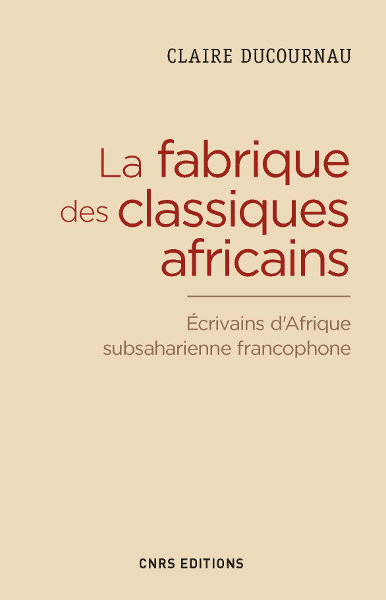
Since Alain Mabanckou’s assumption of the first artistic chair at the Collège de France in 2015– 16, the time seems ripe for some reflection on the dynamics of consecration in and around African literature written in French. Claire Ducournau’s La fabrique des classiques africains: Ecrivains d’Afrique subsaharienne francophone (1960–2012) offers a comprehensive and persuasive account of recent decades. The subtitle here is only slightly misleading: the major focus of the book is actually from 1983 to 2008, a period beginning with Senghor’s election at the Académie française and ending with the littérature-monde manifesto. (A reader interested in dynamics before 1983 can consult Ruth Bush’s recent Publishing Africa in French, which serves as a helpful companion study.) Drawing on sociological, ethnographic, and archival research, Ducournau focuses here on two main ‘protagonists’ in the production of African classics: cultural intermediaries (prizes, literary magazines, agents, editors, festivals) and the writers themselves. A substantial prologue explores the littérature-monde manifesto. Part One looks at institutions of legitimation, focusing on prizes and literary magazines while Part Two offers a data-driven sociological study of African writers working in French between 1983 and 2008. During this timeframe, Ducournau identifies a number of tendencies that characterize recent African literature in French: the rise of the novel at the expense of poetry; the emergence of more female authors onto the scene; the rise in authors basing themselves outside of Africa; and the increasing professionalization of media- savvy authors. Shifting between her two protagonists, Ducournau demonstrates how a sociological approach yields insights into the resources and constraints that permit African writers working in French to accede to literary consecration.
 Tobias Warner