Special Issue of Contemporary French Civilization on “Decolonizing Memory”, vol. 48, no. 1, 2023
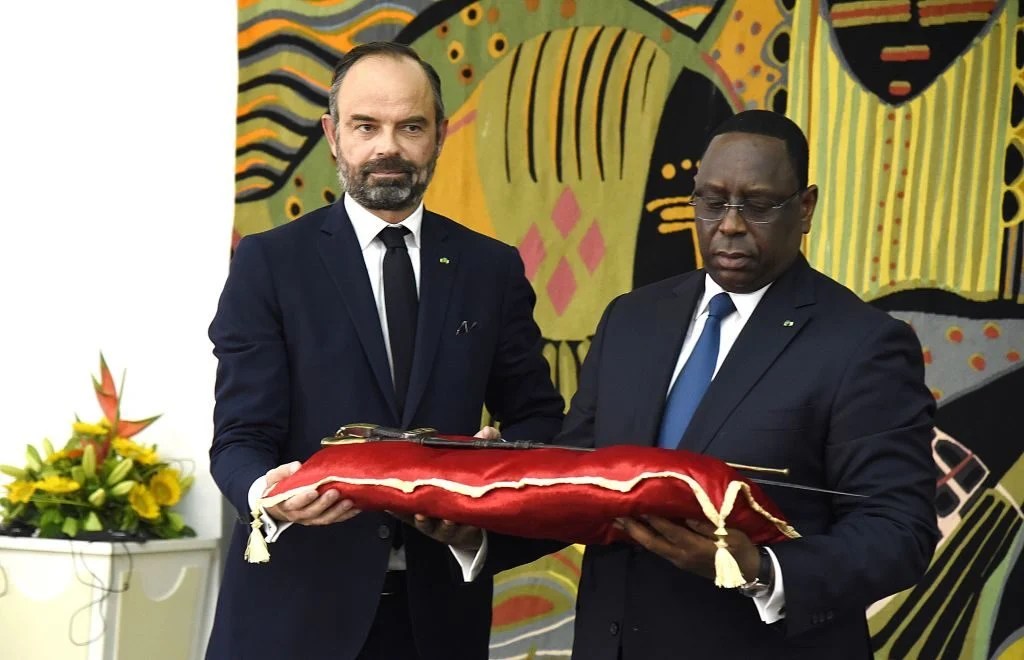
One could sketch a portrait of contemporary debates around decolonizing public memory in France and the francophone world in two objects: the first, a sword on a red velvet pillow exchanged between heads of state; the second, a funeral post, grasped from a museum display in a live-streamed attempt at unauthorized repatriation.
In November 2019, France returned the sword of El Hajj Umar Tal to Senegal. Tal was a nineteenth-century political leader and Islamic scholar who battled the French and built a short-lived West African empire across much of what is now Guinea, Senegal, and Mali. The return of Tal’s sword was the first tangible outcome of the much-discussed 2018 report of Felwine Sarr and Bénédicte Savoy on looted African cultural artifacts in European museums (Sarr and Savoy). If some saw progress in this step, others saw further complication: it was unclear why this object had been chosen among so many others, whether it had even belonged to Tal in the first place, nor why it was being returned to Senegal alone given the fluidity of nineteenth-century borders. But the optics spoke for themselves: in a widely disseminated image, the sword sits between prime minister Edouard Philippe of France and president Macky Sall of Senegal (Macé). This is restitution, the photo op suggests: a material symbol of past conflicts being soberly returned by the accredited representatives of two sovereign nations. A sword evokes conflict, resistance, or confrontation, but to twenty-first- century eyes it also carries the unmistakable whiff of something dépassé. Just as modern wars are no longer fought primarily with sabers, the photo suggested, so too might the colonial past be definitively buried with state- driven gestures such as these.
Just over six months later, a very different scene unfolded in June 2020 when the Congolese-born pan-African activist Mwazulu Diyabanza tried to remove a nineteenth-century Chadian funeral post from the Musée du Quai Branly – the first of a series of actions at other European museums over the following year.
Keep reading / [pdf]
 Tobias Warner