Tobias Warner, Translating the Postcolonial, 2017
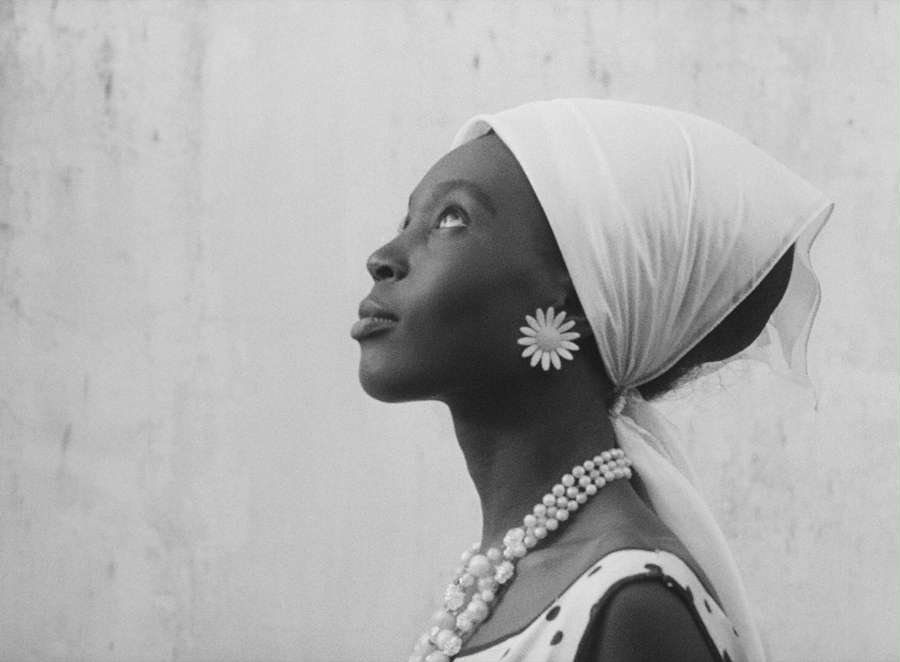
Ousmane Sembène encountered a host of financial, logistical, and bureaucratic problems as he tried to shoot, edit and distribute La Noire de… Although the film would go on to widespread acclaim upon its release, Sembène’s struggles to produce La Noire de… capture the many challenges that francophone African filmmakers faced in the early independence era, a period in which a variety of neocolonial institutions restricted access to capital, regulated the ability to work, and determined which bodies and performances could play a role on screen. […] This essay studies how the constraints imposed on the filmmaking process shaped La Noire de… by forcing Sembène to make key changes to the voices of characters in the soundtrack and to the color of the film stock. Due to his limited budget, Sembène was unable to bring the Sene- galese actress Thérèse M’Bissine Diop, who plays Diouana in the film, to Paris to record her character’s dialogue; instead, Diouana’s speech and interior monologues were recorded separately during post-production, using the voice of the Haitian actress and singer Toto Bissainthe. Lacking the proper accreditation to make a feature also forced Sembène to make other changes: most notably, he had to cut a short sequence in color near the beginning of the film. An all-black-and-white print was distributed instead and this is still the only version of the film that is widely available today. However, an ‘uncut’ version of the film was recently restored by the Archives françaises du film, reinstating the missing color sequence.In this essay, I compare the widely available print with the restored version to analyze how restrictions on voice and color left traces on the finished film itself. My argument is that La Noire de… actually foregrounds these chromatic and sonic constraints, making them into meditations on translatability, postcolonial subjectivity and the limits of authorial expressivity in film. Rather than eliding the headaches he encountered in production, Sembène transforms the changes he had to make into palpable aspects of the viewing experience. La Noire de… draws our attention to its rough edges, to the ways in which Sembène did not get to make the film he wanted to make. The film presents itself a site of translation, turning the restrictions it confronted into an immanent aspect of its aesthetic.
 Tobias Warner